Just add batteries?
For the E23, battery design is driven less by stored energy than by current limits, thermal behaviour, and mass. These constraints shape performance long before capacity becomes the limiting factor.
Once we decided that a high system voltage was the right direction for the E23, it was tempting to think about the battery as an energy problem: work out how many kilowatt‑hours were needed, then package that capacity into the vehicle.
On paper, that sounds reasonable. In practice... Not so much.
For a lightweight vehicle with aggressive, short‑duration demands, the battery is constrained by far more than stored energy. Current delivery, thermal behaviour, and mass all become limiting factors long before you “run out” of kilowatt‑hours.
The reasoning
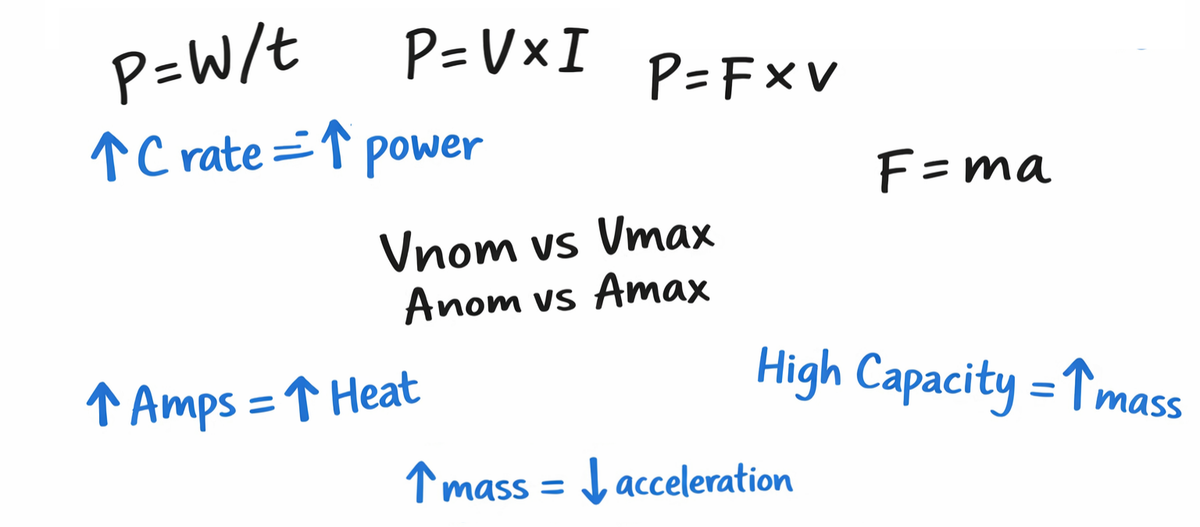
I’m not a professional engineer, and I don’t love maths, but I’m comfortable with the fundamentals like P = V × I and F = m × a. What mattered next was asking a simple question: what happens once current limits, heat, and mass are treated as real constraints?
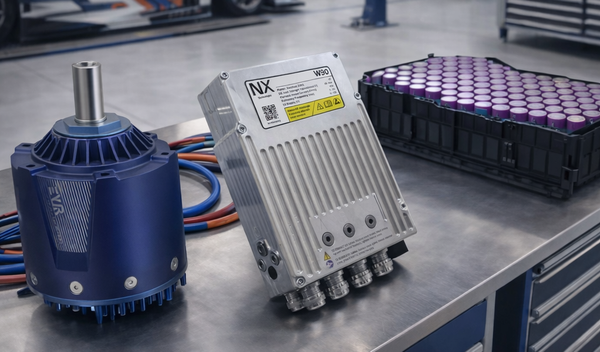
Early on we looked at off‑the‑shelf packs and modules (new packs, used EV modules, and drone batteries) and compared configurations in a spreadsheet: series, parallel, mass, cost, and claimed current capability. The key learning was that batteries don’t behave like a simple fuel tank. The constraints show up in places you don’t notice until you ask a small vehicle to deliver repeated, violent bursts of power.
Where real batteries fall down
Many perfectly good EV batteries fail for reasons that aren’t obvious from a headline spec.
Used EV battery modules (Tesla, VW, Mercedes, etc.) are typically low‑voltage building blocks. In their original vehicles, multiple modules are stacked in series (often six to eight) to reach a base system voltage of 400–800 V, with parallelisation happening inside each module first (“P before S”).
In isolation, a single module may have an acceptable C‑rate. The problem is architectural:
- Reaching a 350–400 V system requires many modules
- Voltage stacking brings mass with it
- By the time voltage is achieved, total battery mass is often measured in hundreds of kilograms
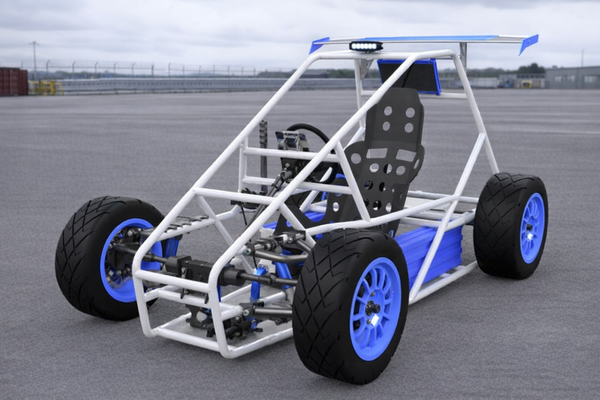
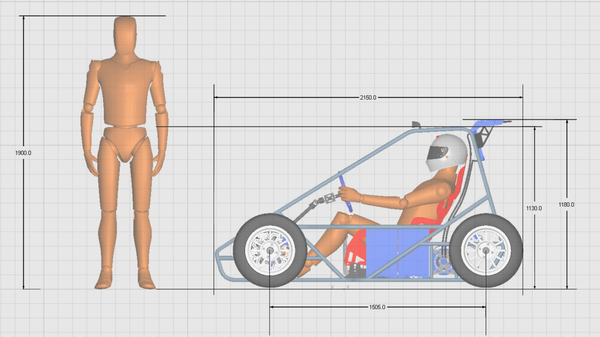
That approach makes sense in a two‑ to three‑tonne passenger car, but not in a ~300 kg buggy.
At the other extreme, industrial drone batteries can deliver very high C‑rates at much lower mass, which makes them attractive for short, violent power bursts. But here a different limitation appears.
Many of these packs rely on internal MOSFET switching and compact BMS architectures that are not rated to tolerate high total series voltage during fault conditions. Stacking them in series can exceed what their internal protection can survive.
Even when current capability and voltage look right on paper, the internal structure of the battery can impose a hard stop.
Power, current, and heat
Battery capacity is usually discussed in kilowatt‑hours. That tells you how long you can run.
Acceleration, however, is driven by kilowatts, and more specifically, by how quickly current can be delivered without exceeding cell limits.
For a given power demand:
- Lower voltage requires higher current
- Higher current increases resistive losses
- Those losses turn directly into heat
C‑rate limits apply at the cell level. Adding cells in series raises voltage but does not increase allowable current. Adding cells in parallel increases current capability, but it also adds mass and thermal load.
Supporting high peak power repeatedly often forces capacity to grow, not because more energy is needed, but because current and thermal limits demand it.
Why mass quietly undermines performance
No one assumes that adding kilowatt‑hours magically creates acceleration. The trap is more subtle.
To meet voltage and current limits with conservative cells, capacity often increases by default. That capacity is not added for performance, but it arrives anyway as mass, often faster than usable peak power increases.
In a light vehicle, extra mass quietly compounds several problems: increased inertia, altered load transfer, and greater tyre load sensitivity. Even when electrical peak power is available, the vehicle becomes harder to accelerate.
Beyond a certain point, additional battery exists mainly to satisfy short‑duration current and thermal demands. The end result is a vehicle that feels heavier, less responsive, and harder to drive the way it was intended.
Summary
For the E23, the battery cannot be treated as a passive energy reservoir. It is a mass‑critical, thermally constrained system that directly limits acceleration and repeatability.
The design question therefore shifts from how much energy is required to how peak power can be delivered without carrying unused mass. The answer to that question drives the architecture that follows.