From constraints to architecture: modular high‑voltage batteries
Designing the E23 battery system: how real-world constraints led to a modular, high-voltage architecture with scalable energy and consistent performance.
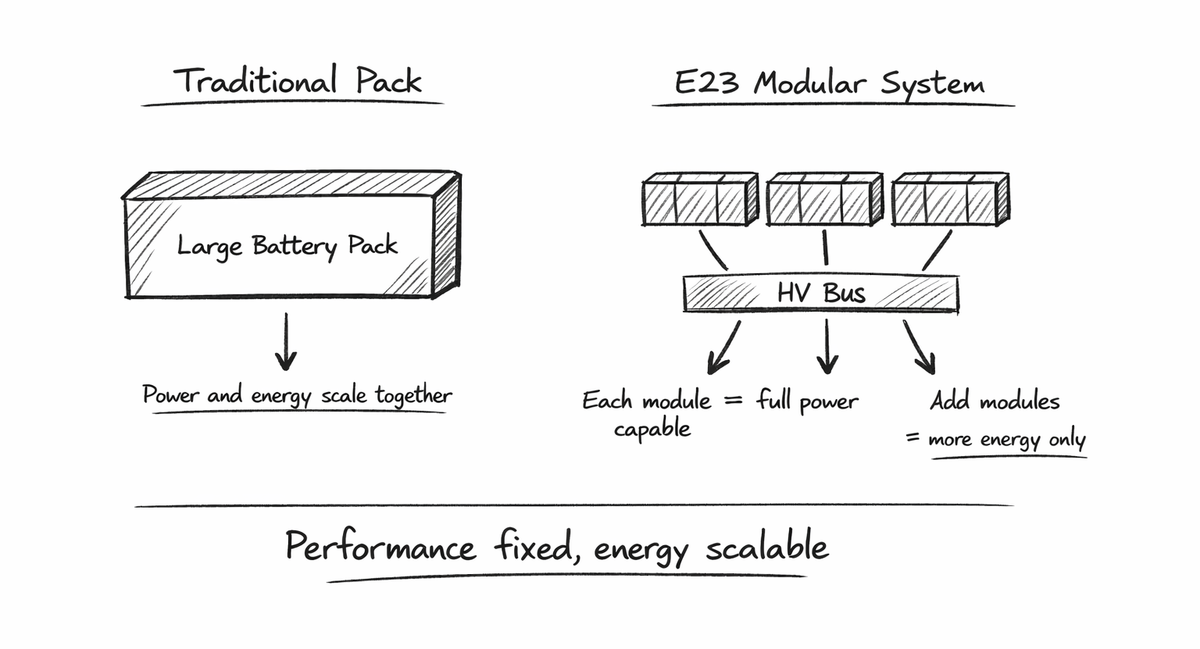
Once current limits, thermal behaviour, and mass growth were treated as first‑order constraints, a single large battery pack was no longer an attractive solution.
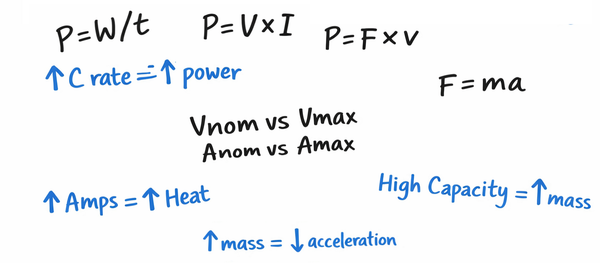
In the previous post, we looked at how current limits, thermal behaviour, and mass growth disrupt the idea that a battery is simply an energy store. Once those constraints are treated as real, the architecture itself has to change.
This post explains how those constraints led to a modular, high‑voltage, swappable battery architecture, and the trade‑offs that decision imposed in an exposed off‑road vehicle.
Decoupling power from energy
The key architectural shift was to separate peak power capability from total energy capacity.
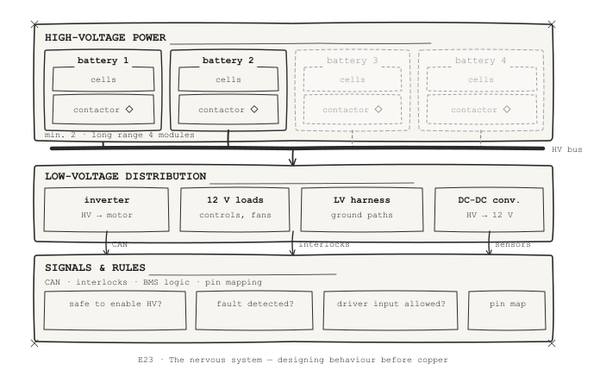
Each battery module is designed to support full peak power on its own. Additional modules add energy without increasing current per cell or changing vehicle performance. This avoids the failure mode where capacity growth silently degrades acceleration.
High voltage as an enabler, not a solution
Higher system voltage reduces current for a given power level, easing conductor sizing and resistive losses. However, voltage alone does not resolve cell‑level thermal limits, mass distribution, or serviceability.
Architecture, not voltage magnitude, determines whether those constraints are manageable.
Modular packs as a structural decision
Breaking the battery into multiple identical modules enables controlled current sharing, distributed mass placement, and redundancy during development and testing.
Each module is a complete, self‑contained system rather than a dependent fraction of a larger pack. This simplifies validation and reduces coupling between energy scaling and vehicle behaviour.
Swappability as a design consequence
In the E23, swappability is not a convenience feature. It allows energy scaling without redesign, enables off‑vehicle cooling between sessions, and simplifies handling, shipping, and service.
A fixed pack optimises for a single operating point. A modular system tolerates a broader range of real‑world use without compromising peak performance.
Safety in an exposed vehicle
High‑voltage systems in off‑road vehicles introduce risks not present in sealed passenger cars. The architecture therefore prioritises physical separation from occupants, touch‑safe connectors and interlocks, and clear mechanical retention with defined load paths.
Modularity increases connector count and potential failure modes. That trade‑off is accepted deliberately and mitigated through conservative design rather than part minimisation.
Compromises and cost
This architecture carries penalties: additional housings and connectors increase BOM cost, packaging efficiency is lower than a monolithic pack, and integration effort is higher during development.
These costs are accepted because they preserve performance consistency and allow future flexibility without re‑architecting the vehicle.
Summary
The E23 battery architecture is not the result of novelty or convenience. It follows directly from treating current limits, thermal behaviour, and mass as non‑negotiable constraints.
With power delivery and energy scaling decoupled, battery mass and placement are now sufficiently stable enough to start defining the next major system: how the vehicle controls and manages that energy.