The E23’s Nervous System: Designing Behaviour Before Copper
Wiring isn’t just connecting components. The E23 electrical system defines behaviour - controlling when power flows and what the vehicle refuses to do.
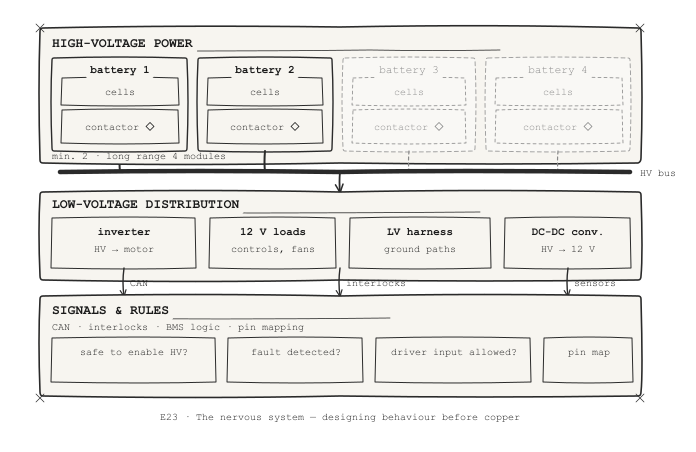
It’s tempting to think of wiring as a late-stage task. You’ve chosen the motor, battery, inverter, controllers. You know your power levels and roughly where everything sits. So the wiring becomes a matter of joining dots.
That’s the assumption.
The reality is different. Wiring is where a system stops being an idea and starts becoming behaviour — not just what it can do, but what it will refuse to do.
Systems Are Defined by What They Refuse
Earlier in the E23 development, simple ideas kept breaking down under real constraints. Power looked simple. Batteries looked like energy storage. Voltage looked like a number. Then current, heat, mass, and availability showed up and changed everything.
The same thing happens again with wiring.
At this point, the major pieces are in place:
- HV and LV systems are defined schematically
- Components are selected and largely available
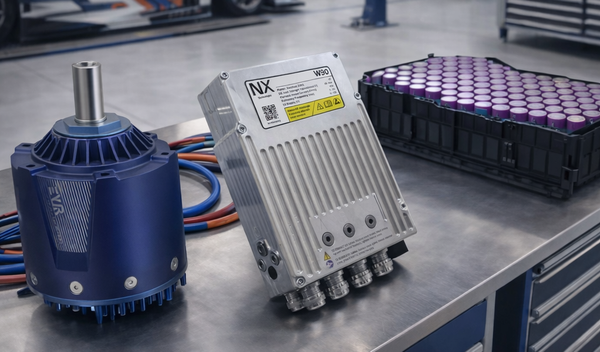
- Motor, inverter, and BMS are on the way
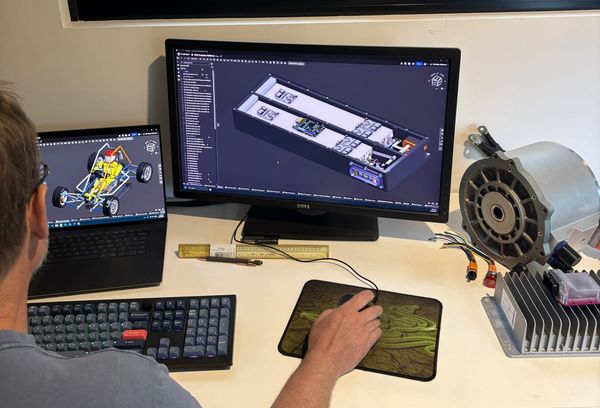
- Battery design is moving from schematic into CAD
It would be easy to think wiring is just implementation. Instead, it’s where you prove the system can behave the way you think it will.
The Three Layers
Strip the system back and it becomes clearer. The E23 electrical architecture falls into three layers.
High-voltage power — energy from the battery to the motor and support systems. Important, but only half the story.
Low-voltage distribution — the 12 V system that brings the vehicle to life. Without it, nothing turns on.
Signals and rules — CAN, interlocks, sensors. This is where decisions are made:
- Is it safe to enable HV?
- Has something failed?
- Should the driver’s input be allowed?
This is what turns hardware into a machine.
When a Schematic Isn’t Just a Drawing
Completing the HV and LV schematics sounds like documentation. It isn’t. It’s where behaviour gets locked in.
The HV system now has defined logic:
- when it can energise
- how it shuts down
- what happens when something goes wrong
The LV system now has defined intent:
- every load has a source
- every control has a purpose
- every ground path is deliberate
There are no “we’ll figure it out later” connections left.
When Parts Become Real
At the same time, the project is shifting out of abstraction.
Components are no longer placeholders:
- LV parts are specified and largely purchased
- Motor, inverter, and BMS are inbound
- Battery design is moving into detailed CAD
- Cells are being procured
That changes the problem. Connectors become constraints. Routing becomes geometry. Mounting points start to fix themselves.
The question stops being: “Can this work?”
It becomes: “This has to work like this — does it still make sense?”
The Quiet Critical Step: Pin Mapping
One of the least visible steps in this phase is also one of the most important — pin mapping.
On the surface it’s simple: assign inputs, outputs, connectors.
In reality, it’s a validation step. It answers a more important question:
Can the system actually express the behaviour we’ve designed?
This is where issues show up early:
- A signal you assumed existed… doesn’t
- Two faults look identical to the system
- An interlock can’t be observed the way you planned
- A control path isn’t actually controllable
These aren’t electrical faults. They’re definition problems.
Catching them now is the difference between a clean bring-up and a long debugging process later.
Wiring States, Not Components
By this point, a pattern becomes clear. We’re not wiring components — we’re wiring states.
Every circuit answers a question:
- Under what conditions can HV be enabled?
- What forces a shutdown?
- What must always stay alive?
Every connector answers another:
- What can be unplugged safely?
- What must never be ambiguous?
- What has to be serviceable trackside?
Every signal becomes a contract between hardware and software. This is where predictability is built — or lost.
Where This Leaves the E23
The system has crossed a quiet threshold. It’s no longer conceptual.
- Power paths are defined
- Control logic is defined
- Interfaces between systems are defined
- Behaviour has been tested against real constraints
The next stage is different again. This moves out of diagrams and into hardware:
- HV switching gets built
- LV harnesses become real looms
- Components arrive and get connected
- The first system bring-up begins
And the question changes again.
Not “does it make sense?”
But: does it actually behave the way we expect?